Alappuzha is a town in Kerala, India with picturesque scenery and includes canals, backwaters, beaches, and lagoons. It is sometimes described as Venice of the East.
A few memories, sentiments and tales of my travels mainly in India, an attempt at photography, and at times, some reflections on other topics.
November 2, 2010
When time stands still...
Go visit our beautiful world around the globe at My World Tuesday.
~~~
Look upon the verdant green hills...
November 1, 2010
Hello Mellow Yellow
This picture was shot while at a store, and I think it is apt for the occasion.
Here's another one and it also includes the skeleton of Paul, the Octopus from Oberhausen who died a few days back. (I guess its tentacles are bound together in sets of two...haha!) Oh, to those sensitive ones out there, I agree with you, it is not right to make jokes of Paul's death. At least not now, when it's ink has not dried yet...haha!October 31, 2010
Halloween Fun
October 30, 2010
October 28, 2010
Somvati Kund
Thanks to the Skywatch team members, we now have a variety of skies to enjoy. Go now and admire as many as you can.~~~
Rainy season is a good time to explore the beauty of Mandu in Madhya Pradesh. There are a number of interesting places to see in Mandu.
Slightly to the left, off the main road is Darya Khan’s Group of Monuments. Darya Khan is known to be an officer in the court of Sutan Mahmud II who ruled in the 16th century.
October 25, 2010
A Rural Experience
My World is a place where you show visitors to your blog the area around you and become their virtual tourist guide.~~~
I was in Ajmer last month, and got an opportunity to spend some time in a few villages there. Gudi was one such village.
In Gudi, the villagers were seen working hard, whether it was with their agricultural jobs, or taking care of their simple homes and families. Others looked busy either milking a cow or tending to their fruits and vegetables garden.
At the sight of freshly picked vegetables (perhaps botanically, fruits) I was tempted to taste the stuff.
When told that it needed to be cooked, I grabbed the opportunity to cook it in an open air fire-place situated at the edge of a vegetable patch. The vegetable dish was bitter, but fresh, and I did end up eating quite a bit of it.
All along, there was a cute little fellow looking down at us from a nearby tree.
In addition to tasting a few more varieties of local delicacies, I also got a chance to enjoy some delicious home-made lassi (yoghurt) and dal baati (lentil soup with steamed balls of cereal) along with generous servings of ghee.
The residents of Gudi looked self-sufficient, and it made me feel their peaceful life in the village made them content, and healthy in mind and body. Look at the serenity on the face of this woman, who has quite a few grandchildren living with her!
It was good interacting with the village folks. Their simplicity and warm hospitality is a typical characteristic of rural values. It made me wonder if it is a good idea for us to switch to a simpler urban life. What do you think?
October 22, 2010
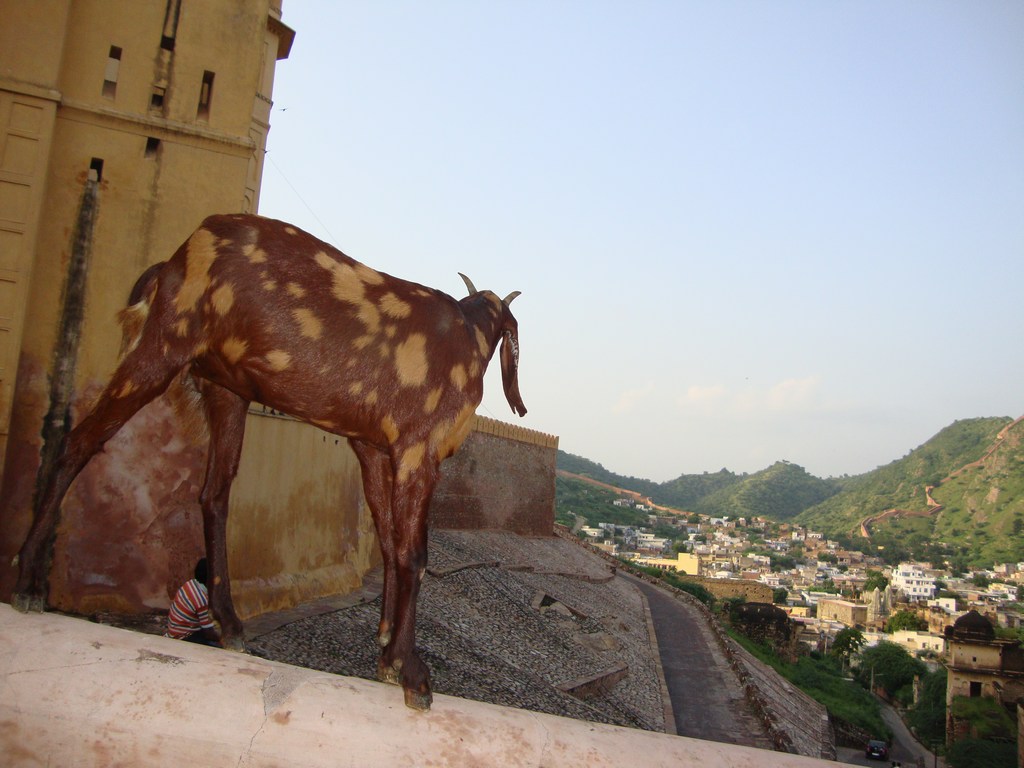
The Goat at the Fort
September 30, 2010
Green Rajasthan
I’m back from my Rajasthan trip.
The first thing that impressed me most about this trip was the lush greenery throughout the regions I travelled. Of course, abundant rains this year is the main reason for it. After all, Rajasthan is not just about being a Registhan (desert)! Gazing at the lush Aravalli mountains range, especially on misty mornings, was delightful.
My tour included travelling mainly around Jaipur and Ajmer divisions of the State. My second visit to the capital Jaipur, exploring areas in and around Ajmer, spending an evening in Pushkar, a visit to the historical town of Neemrana in the Alwar District, and a day’s excursions to Nathdwara in the Rajsamand district sums it up.
The highlights of my trip are:-
1. A visit to Amer (Amber) Fort that I had missed for want of time during my last trip to Jaipur in 2007. I also got an opportunity to visit the Jaigarh and Nahargarh forts again. Forts do not fail to fascinate me, and Amber Fort is particularly impressive.


Here are a few more of the many photographs of my travels:-
Chaos on a street in Jaipur with protesters intensifying their agitation (photograph shot from a moving vehicle on 14 September 2010)...

Lit up Hawa Mahal or the Palace of Winds and its so-called 953 jharokhas (small windows)...

The magic of lush green hills and still waters of the Maota Lake...

Passing through a village one late evening in Pushkar...

From posh city homes...

To humble village dwellings....

A view of Neemrana town from the Palace-Fort...

The first thing that impressed me most about this trip was the lush greenery throughout the regions I travelled. Of course, abundant rains this year is the main reason for it. After all, Rajasthan is not just about being a Registhan (desert)! Gazing at the lush Aravalli mountains range, especially on misty mornings, was delightful.
My tour included travelling mainly around Jaipur and Ajmer divisions of the State. My second visit to the capital Jaipur, exploring areas in and around Ajmer, spending an evening in Pushkar, a visit to the historical town of Neemrana in the Alwar District, and a day’s excursions to Nathdwara in the Rajsamand district sums it up.
The highlights of my trip are:-
1. A visit to Amer (Amber) Fort that I had missed for want of time during my last trip to Jaipur in 2007. I also got an opportunity to visit the Jaigarh and Nahargarh forts again. Forts do not fail to fascinate me, and Amber Fort is particularly impressive.
2. Staying with, and consequently getting an opportunity for close interaction with, a wonderful Rajput family for quite a few days. Together with some of their family members, I visited 3 different villages in and around Beawar in the Ajmer District: Borwa, Masud and Gudi. Gracious hosts, I could learn more on the true meaning of hospitality from them.
3. Zipping (Zip-lining) with the FlyingFox in Neemrana at its Palace-Fort. That was fun!
Here are a few more of the many photographs of my travels:-
Chaos on a street in Jaipur with protesters intensifying their agitation (photograph shot from a moving vehicle on 14 September 2010)...
Lit up Hawa Mahal or the Palace of Winds and its so-called 953 jharokhas (small windows)...
The magic of lush green hills and still waters of the Maota Lake...
Passing through a village one late evening in Pushkar...
From posh city homes...
To humble village dwellings....
A view of Neemrana town from the Palace-Fort...
Of course, travels include other interesting activities like a taste of local cuisine and culture, arts and crafts, songs and dances, the Kesariya baalam and sarangi, the "special" badam milk and laughter to follow, and other obvious delights...

The next time I go to Rajasthan, I wish to have a pure Registhan experience.
September 9, 2010
On Travels and Stories
My schedule has been hectic lately. In spite of that, I had begun writing the most important story of Mandu: the love story of Baz Bahadur and Roopmati. To those interested in my posts on Mandu, unfortunately I cannot continue that now because, fortunately I have got another opportunity to travel, thanks to Eid holidays in this part of the world.
So I am setting out on another journey, taking a flight to Jaipur in a few hours and then shall see where the road takes me from there.
Once back, I hope to complete writing my unfinished story and post it. Until then, ciao!
September 2, 2010
C'est Magnifique
~~~
Until I reached Mandu I did not know who Hoshang Shah was. Travel does introduce us to, inter alia, interesting historical figures that we would not have otherwise bothered to find out about, isn’t it?
At the first glance of Hoshang Shah’s Mausoleum in Mandu, the initial thought that crops up is: C'est Magnifique (It's Magnificent).
I do not know much neither about his life and achievements, nor about the circumstances of his death but having read a bit about him, now I know Hoshang Shah is remembered as a warrior with a sympathetic heart and dearly loved by his subjects. It was he who made Mandu one of the most impregnable forts of India. He ruled Malwa for 27 years.
Looking at the gleaming Mausoleum sheathed entirely in white marble, I also think of the Taj Mahal. The work on the Mausoleum was begun by Hoshang Shah himself, who died in 1435, and the work was completed by Mahmoud Khilji in AD 1440. It is probably one of India’s earliest marble structure based on Afghan architecture.
I am not surprised at the claim that Shah Jahan was so impressed by the Mausoleum that he sent a team of his architects to Mandu to study its design before commencing construction of the Taj Mahal. Certainly some inspiration may have been drawn from this Mausoleum. To the uninitiated, the Taj Mahal was completed in and around AD 1648.
I notice the quadrangle on which the Mausoleum is built, and am particularly drawn to its large white dome with smaller cupolas at the corners. The entrance is through a porch.
As expected at Mausoleums, I take off my footwear and step in quietly. The light filtering through its delicately beautiful lattice work gives the place an exquisite effect. The atmosphere is amazingly serene.
Much later, once out, I choose a spot in the calm surroundings at one of the porches supported by decorative colonnades in the western part of the Mausoleum.
The neat garden has many flowering plants. Many jasmine shrubs are in full bloom spreading fragrance around the austere place.
Dark clouds begin to roll across the blue sky, its edges folded in silver.
As the rain is about to pour down, I prepare to leave the Hoshang Shah’s Mausoleum to explore another monument in the vicinity. Glancing back one last time, I think: Death not only ends life; to some, it also bestows upon it a beautiful completeness.
~~~
Mandu can be reached by road from Indore via Dhar, and the nearest airport is in Indore (100 kms). The nearest railheads are Indore and Ratlam (120 km).
Subscribe to:
Posts (Atom)